 Help Center
Contact Management
Contact Management
Creating and Saving Contacts filters
Filters let you narrow the Contacts Dashboard, Sales Pipeline, or Financial Accounts pages to just the records you care about. Saved filters give you one-click access to the same view every time.
Where Filters Are Available
- Contacts Dashboard
- Sales Pipeline
- Financial Accounts
Note: Saved filters created on one page are not shared across pages. Each page has its own saved filter list.
Ways to Filter
Depending on the page you are viewing, you may see several filtering options:
- Stage tabs — use the stage tabs at the top of the Sales Pipeline to narrow contacts by stage.
- Date filter — click the calendar icon to filter by Created At date.
- Sort — click the sort icon to sort by created or updated date.
- Saved Filters — click the filter icon with a heart to apply a saved filter.
- Segments — click the group-of-people icon to apply one of your saved segments directly from the current list.
- Add Filter — click the filter icon to create a quick single-field filter.
- Advanced Filters — use advanced filters for multi-field logic with AND / OR conditions.
Create a Quick Filter
- Click the filter icon above the table.
- The Filters panel opens.
- Select a field, such as Stage, Source, Tag, or another available field.
- Choose the filter value.
- Apply the filter to update the page results.
Quick filters are useful when you only need to filter by one field or make a simple adjustment to the current view.
Build an Advanced Filter
Use Advanced Filters when you need more detailed logic, multiple conditions, or reusable audience criteria.
- Click the filter icon to open the Filters panel.
- Click Advanced Filters.
- Choose an existing saved segment, or click Create one-time use segment.
-
Add conditions. Each condition includes a field, an operator, and a value.
Common fields include:
- Stage, Category, Tag, Source, Owner
- Created At, Last Updated
- Date of Birth, Age
- Custom fields
- Combine conditions with AND or OR.
- Optional: add rules under Appointment filters, Account filters, or Event filters (see the sections below).
- Click Apply.
Example: Clients Nearing RMD
- Category equals Client
- AND Age is greater than 72
Example: Hot Pipeline
- In Pipeline? equals Yes
- AND Stage is in First Appointment or Pending
- AND Owner equals Me
Use Number Field Operators
Number fields support comparison operators that help you build exact values, open-ended ranges, and inclusive ranges.
- Equals — find records with an exact number
- Does not equal — exclude records with a specific number
- Is greater than — find values above the number you enter
- Is greater than or equal — find values at or above the number you enter
- Is less than — find values below the number you enter
- Is less than or equal — find values at or below the number you enter
- Exists — find records where the number field has a value
- Does not exist — find records where the number field is blank
For example, use Age is greater than or equal to 72 when you want to include contacts who are exactly 72 and contacts older than 72.
Filter by Age
You can filter contacts by Age in Advanced Filters. Age is calculated automatically from the contact's Date of Birth, so you do not need to maintain a separate age field manually.
- Go to the Contacts page or Sales Pipeline.
- Click the filter icon to open the Filters panel.
- Click Advanced Filters.
- Search for or select Age.
- Choose a condition.
- Enter the age in years, and optionally add months and days.
- Click Apply.
Available Age Conditions
- Equals — find contacts of an exact age
- Does not equal — exclude contacts of a specific age
- Is greater than — find contacts older than a given age
- Is greater than or equal — find contacts at or above a given age
- Is less than — find contacts younger than a given age
- Is less than or equal — find contacts at or below a given age
- Exists — find contacts with a Date of Birth on file
- Does not exist — find contacts missing a Date of Birth
What You Can Enter
- Years — required, such as 59
- Months — optional, from 0 to 11
- Days — optional, from 0 to 31
Examples
- Age equals 65 — find contacts who are currently 65
- Age is greater than or equal to 59 years and 6 months — find contacts who are at least 59 and a half today
- Age is less than or equal to 55 plus Category = Client — find clients at or below a selected age
- Age is greater than or equal to 65 and Age is less than or equal to 75 — build an inclusive age range
Important: Age is calculated from the contact's Date of Birth relative to today. Saved filters that only use years, such as Age is greater than or equal to 65, keep working as before. Contacts without a Date of Birth will only match the Does not exist condition.
Filter by Appointments
Below your contact rules, advanced filters have an AND · Appointment filters section. Use it to find contacts based on their meetings. A contact shows up only when they match your contact rules and your appointment rules.
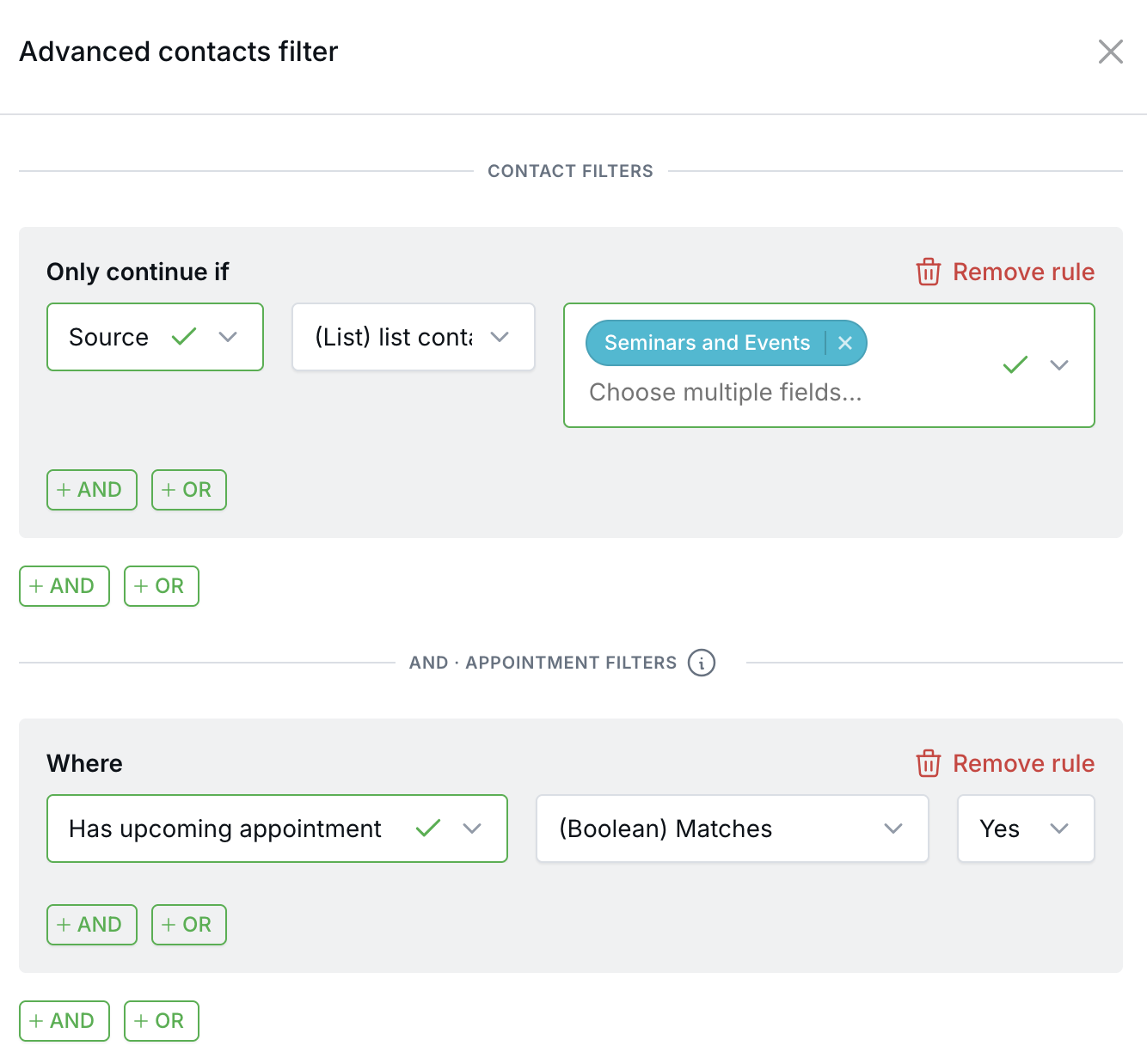
Contact rules on top, appointment rules below. Contacts must match both.
Appointment Fields
- Status, Subject, Date, Category, Host, Meeting type, Meeting location
- Number of appointments: counts appointments and internal meetings in any status, but not time blocks
- Has upcoming appointment: a future appointment that is Tentative or Confirmed (choose Yes or No)
When you add several appointment rules, use AND if all of them must be true for the same appointment, or OR if any one is enough.
Examples
- Clients with a meeting coming up: Category is Client, AND Has upcoming appointment → Matches → Yes
- Contacts who have never had an appointment: Number of appointments → Equals to → 0
- Missed meetings to follow up on: appointment Status is No show or Cancelled
- One advisor's meetings: appointment Host is that advisor
Appointment rules are saved with your segments, so you can reuse these lists anytime.
Filter by Accounts
Under the appointment card, advanced filters have an Account filters card. Use it to find contacts based on their financial accounts. A contact shows up only when they match every card that has rules: contact, appointment, account, and event.
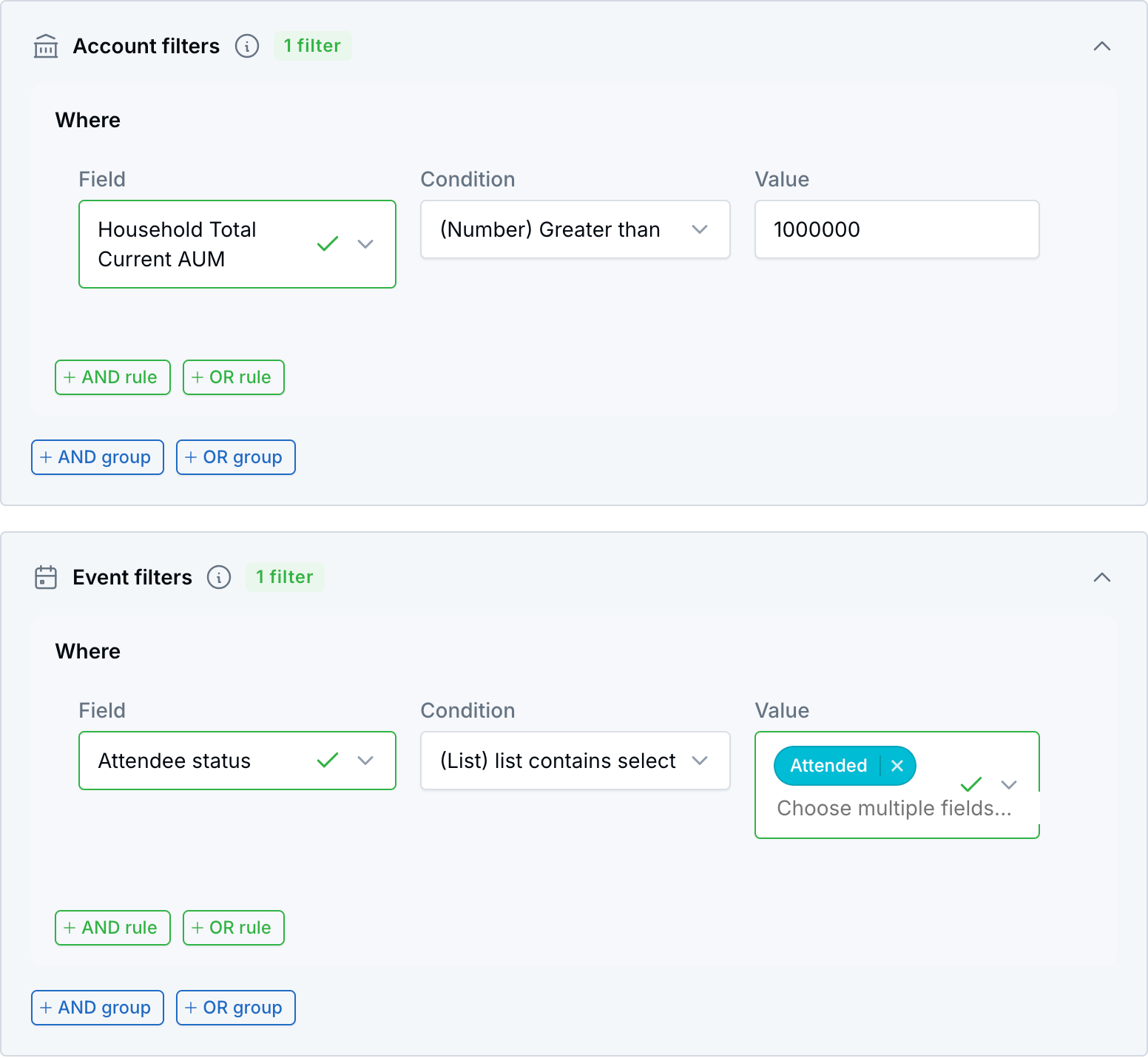
Households with more than $1 million in Household Total Current AUM that attended an event, built with the Account and Event filters cards.
Account Fields
- Account status, Account type, Account tax type, and Writing advisor
- Insurance company and Insurance product
- Meet RMD requirements and Is replacement
- Account issued year and App signed year
- Orion sleeve type, when Orion is connected, and your account custom fields
When you join these rules with AND, they must all be true for the same account. OR means any one of them is enough. Doesn't contain leaves out a contact when any of their accounts matches.
Totals for the Contact and the Household
These totals match the ones on the contact's Accounts tab. Each one adds up issued accounts of that kind, including related accounts. Pending, cancelled, and deleted accounts aren't counted.
- Total Issued AUM and Total Current AUM
- Total Issued Insurance and Total Current Insurance
- Total Planning fees: the issued amount on issued financial planning accounts.
- Number of accounts: how many accounts the contact has, in any status.
- Household Total Issued AUM, Household Total Current AUM, Household Total Issued Insurance, Household Total Current Insurance, and Household Total Planning fees: the same totals for the contact and everyone in their family, with each person counted once. A contact who isn't in a family counts as a household of one.
- Household issued date: any account in the household whose issued date matches, in any status.
If you combine a household rule with Account status, the status is checked on the contact's own accounts and the household rule across the family.
Examples
- Households over $1 million: Household Total Current AUM → Greater than → 1000000
- One carrier's policyholders: Insurance company is that carrier, AND Account status is Issued
- Clients with no accounts yet: Category is Client, AND Number of accounts → Equals to → 0
Filter by Events
Below the account card, the Event filters card finds contacts based on the events they registered for.
Event Fields
- Event, Event status (Draft, Scheduled, Completed, or Cancelled), Event type (such as Retirement Workshop, Webinar, Livestream, Lunch and Learn, or Educational Event), Event source, and Event date
- Attendee status: Waitlist, Registered, Confirmed, Cancelled by us, Cancelled by attendee, No show, Attended, Requested appointment, or Appointment scheduled
- Attendee type: Main attendee or Guest
- Number of events: how many events the contact registered for, in any attendee status
When you join these rules with AND, they must all be true for the same registration. The event list shows the internal campaign name when the event has one.
Examples
- Workshop attendees to follow up with: Event type is Retirement Workshop, AND Attendee status is Attended
- No-shows for a replay email: Event is last month's event, AND Attendee status is No show
- Your most engaged guests: Number of events → Greater than or equal → 3
Account and event rules are saved with your segments. Segments saved before these cards were added keep working with their existing rules.
Save, Apply, and Delete a Filter
Save a Filter
- Apply your filter.
- Click the Save button, shown as a floppy disk icon.
- Enter a name for the filter.
- Optionally mark the filter as Private so only you can see it.
- Click Save.
Apply a Saved Filter
- Click the filter icon with a heart to open saved filters.
- Select the filter from the dropdown list.
Apply a Segment from the Toolbar
Use the Segments icon to apply a saved segment without leaving the Contacts page or Sales Pipeline.
- Go to Contacts or Sales Pipeline.
- Click the Segments icon in the filter toolbar. It appears next to the Saved Filters icon.
- Select a segment from the dropdown. The current list reloads using that segment’s conditions.
- To switch segments, open the dropdown again and select a different segment.
- To clear the segment and return to the full list, click the Reset filters icon.
- The dropdown lists your segments in alphabetical order.
- If you do not have any segments yet, the dropdown shows a message and a Manage segments link.
- Applying a segment from this dropdown replaces the current segment selection rather than stacking another one on top.
- Applying a segment from this dropdown clears simple filters on the page, similar to applying a saved filter.
- The selected segment is reflected in the URL, so refreshing the page keeps the same filtered view.
- Manage segments opens the Contact segments page where you can create, edit, duplicate, or delete segments.
Delete a Saved Filter
- Click the filter icon with a heart to open saved filters.
- Find the filter you want to remove.
- Click the trash icon next to the filter name.
Note: Private filters are only visible to the user who created them.
Which Field Should I Use?
| Goal | Use | Why |
|---|---|---|
| Broad classification | Category | One per contact and useful for reporting. |
| Overlapping labels | Tag | A contact can have multiple tags. |
| Typed data such as number, date, or currency | Custom field | Consistent field type with better operators. |
| Pipeline position | Stage | Pipeline-specific and used in reports. |
| Marketing attribution | Source / Original Source | Feeds ROI and CAC reports. |
Best Practices
- Save filters you use regularly. Rebuilding the same filter repeatedly wastes time.
- Use private filters for personal views and public filters for team views.
- Pair a saved filter with a bulk action to standardize recurring operations.
- Audit saved filters periodically. Delete filters that are out of date.
- Use segments for reusable audiences instead of rebuilding the same logic across filters.
Frequently Asked Questions
Can I share a private filter with a teammate?
No. To share it, unmark Private and save it as a public filter, or rebuild the filter as a segment.
Why does my saved filter return fewer contacts than I expect?
Check whether the filter is restricted to a specific stage tab, date filter, search term, or another active filter. The active filter chips at the top show what is currently applied.
Can I filter on custom fields?
Yes. Custom fields are available in Advanced Filters. Each custom field supports operators appropriate to its type, such as equals or greater than for numbers, and before or after for dates.
How is Age filtered for contacts without a Date of Birth?
Contacts without a Date of Birth match only Age does not exist. All other Age conditions exclude them.
Related Articles

Need more help?
If you can't find the answers you're looking for, our support specialists are available to answer your questions and troubleshoot if necessary.
-
Phone Call (888) 291-7116. Our main hours are Monday to Friday 7 am-5 pm Central Time.
-
Support Send your questions and inquiries via email to support@leadcenter.ai. A support ticket will be created and one of our team members will get back to you as quickly as possible.